Metallurgical Engineering

Metallurgical Engineering

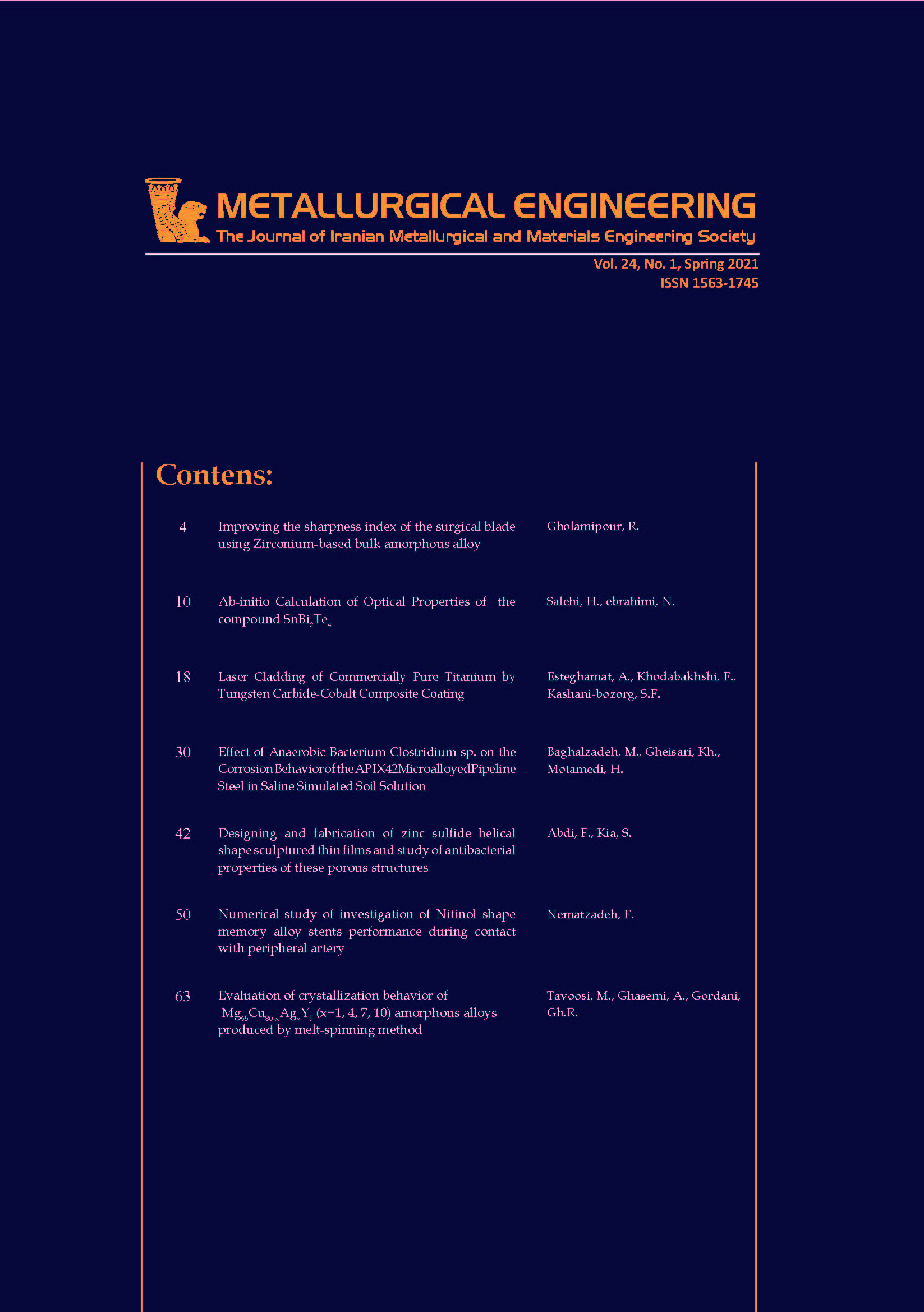
Evaluation of crystallization behavior of Mg65Cu30-xAgxY5 (x=1, 4, 7, 10) amorphous alloys produced by melt-spinning method

Document Type : Research Paper

Authors
1 Associate Professor, Materials Engineering Department, Malek Ashtar University of Technology, Isfahan, Iran.
2 Professor, Materials Engineering Department, Malek Ashtar University of Technology, Isfahan, Iran.
3 Assistant Professor, Materials Engineering Department, Malek Ashtar University of Technology, Isfahan, Iran.
Abstract
In the present work, the effects of substitution of Ag with Cu on thermal behaviors of Mg-Cu-Y based amorphous alloys were investigated. In this regards, four different (x=1, 4, 7, 10) Mg65Cu30-xAgxY5 alloys were melt spinned at same condition. The structural and thermal characteristics of prepared alloys were examined using X-ray diffraction (XRD) and differential scanning calorimetric (DSC) techniques. Based on results, the substitution of Ag with Cu in Mg-Cu-Y alloys had significant effects on thermal behavior of prepared samples. Although, the crystallization mechanism of prepared amorphous phase in different alloys was the same, the Mg65Cu23Ag7Y5 alloy (in the presence of 7 at. % of Ag) showed higher thermal stability in comparison to others. The crystallization activation energy of prepared amorphous alloys was estimated about 150-200 kJ mol-1. Based on the calculated values of Avrami exponent (1.5<n<1.7), the crystallization process in different systems were the same as a three-dimensional diffusion-controlled growth.
Keywords

  1. طاووسی، م.، سعیدی، ن.، "فلزات شیشه‌ای و آلیاژهای آمورف- نانوکریستال"، انتشارات دانشگاه صنعتی مالک اشتر، 1392.
  2. H.E. Friedrich, B.L. Mordike, Magnesium technology, Springer, 2006.
  3. Kang, H.G., Park, E.S., Kim, W.T., Kim, D.H., Cho, H.K., “Fabrication of bulk Mg-Cu-Ag-Y glassy alloy by squeeze casting”, Materials Transactions, Vol.41, pp 846-849, 2000.
  4. Amiya, K., Inoue, A., “Thermal stability and mechanical properties of Mg-Y-Cu-M
    (M=Ag, Pd) bulk amorphous alloys”, Materials Transactions, Vol.41, pp 1460-1462, 2000.
  5. Rozenberg, S., Audebert, F., Galano, M., Vergara Ogando, I., Mendive, C., “Effect of Al addition to Rapidly Solidified Mg-Cu-Rare Earth Alloys”, Material Research, Vol. 19, pp. 273-281, 2016.
  6. Hyun, J.I., Kong, K.H., Kim, W.C., Kim, W.T.,  Kim, D.H., “Formation of nanoporous Cu-Ag by dealloying Mg-Cu-Y-Ag amorphous alloys and its electrocatalyst oxidation property”,
    Intermetallics
    , Vol. 110, pp. 106488, 2019.
  7. Amiya, K., Inoue, A., “Preparation of bulk glassy Mg65Y10Cu15Ag5Pd5alloy of 12 mm in diameter by water quenching”, Materials Transactions, Vol. 42, pp 543-545, 2001.
  8. Men, H., Hu, Z.Q., Xu, J., “Bulk metallic glass formation in the Mg-Cu-Zn-Y system”, Scripta Materialia, Vol.46, pp 699-703, 2002.
  9. Madge, S.V., Greer, A.L., “Effect of Ag addition on the glass-forming ability and thermal stability of Mg-Cu-Y alloys”, Materials Science and Engineering: A 375-377, pp 759-762, 2004.
  10. Duwez, P., “Metallic glasses-historical background”, in: Glassy Metals, pp. 19-23, Springer, 1981.
  11. Chattopadhyay, C., Satish Idury, K.S.N., Bhatt, J., Mondal, K., Murty, B.S., “Critical evaluation of glass forming ability criteria”, Materials Science and Technology, Vol. 32, pp. 380-400, 2016.
  12. Inoue, A., “Stabilization of metallic supercooled liquid and bulk amorphous alloys”, Acta Materialia, Vol. 48, pp. 279-306, 2000.
  13. Zhang, X., Cui, X., Du, Z., Zu, F., Li, J., Bian, B., Xu, K., Zhang, X., “On glass forming ability of bulk metallic glasses by relating the internal friction peak value”, Metals, Vol. 10, pp. 767-775, 2020.
  14. Lu, Z.P., Liu, C.T., “A new glass-forming ability criterion for bulk metallic glasses”, Acta Materialia, Vol. 50, pp. 3501-3512, 2002.
  15. Wang, G., Guo, C., Pang, S., “Thermal stability, mechanical properties and corrosion behavior of a Mg-Cu-Ag-Gd metallic glass with Nb addition”, Rare Metals,Vol. 36, pp.304-308, 2017.
  16. Busch, R., Schroers, J., Wang, W.H., “Thermodynamics and kinetics of bulk metallic glass”, MRS Bulletin, Vol. 32, pp. 620-623, 2007.
  17. Pang, J., Wang, Y., Tan, M.J., Liew, K.M., “Thermal properties of metallic glasses: Heating rate dependence and their correlation”, Materials Letters, Vol. 126, pp. 81-84, 2014.
  18. Fang, S., Xiao, X., Xia, L., Wang, Q., Li, W., Dong, Y., “Effects of bond parameters on the widths of supercooled liquid regions of ferrous BMGs”, Intermetallics, Vol. 12, pp. 1069-1072, 2004.
  19. M.C. Weinberg, “Glass-forming ability and glass stability in simple systems”, Journal of Non-Crystalline Solids, Vol. 167, pp. 81-88, 1994.
  20. Wang, W.H., Dong, C., Shek C.H., “Bulk metallic glass”, Material Science Engneering R, Vol. 44, pp. 45-89, 2004.
  21. Avrami, M., Kinetics of phase change. II transformation‐time relations for random distribution of nuclei, The Journal of Chemical Physics, Vol. 8, pp. 212-224, 1940.
  22. Lu, K., Wang, J.T., “Activation energies for crystal nucleation and growth in amorphous alloys”, Materials Science and Engineering A, Vol.133, pp. 500-503, 1991.
  23. Flynn, J.H., Wall, L.A., Quick, A., “Direct method for the determination of activation energy from thermogravimetric data”, Polymer Letter, Vol.4, pp. 323-328, 1966.
  24. Kissinger, H.E., “Reaction kinetics in thermal analysis”, Analytical Chemistry, Vol. 29, pp. 1702-1706, 1957.
  25. Ozawa, T., “A new method of analyzing thermogravimetric data”, Bulletin of the Chemical Society of Japan, Vol. 38, pp. 1881-1886, 1965.
  26. Ozawa, T., “Kinetics of non-isothermal crystallization”, Polymers, Vol.12, pp.1508-1526, 1971
  27. Ranganathan, S., Heimendah, M.V., “The three activation energies with isothermal transformations: applications to metallic glasses”, Journal of Materials Science, Vol. 16, pp.2401-1407, 1981.

  • Receive Date 19 April 2021
  • Revise Date 29 September 2021
  • Accept Date 20 November 2021